

By: Kody Cook
Source: This article was originally published in Council Magazine, Dec 2025
As councils across Australia face new community engagement requirements, the ability to collect, analyse and apply robust community data is becoming essential.
In recent years, local government has faced growing expectations around community engagement and transparency. For councils and regional authorities, the ability to genuinely capture and reflect community sentiment is no longer a pipe dream
By adopting data-driven engagement tools such as Place Score, local governments can move beyond consultation to gain actionable insights, strengthen reporting, and build greater trust with their communities.
Putting data at the heart of decisions
Place Score is a national social research company that delivers representative community engagement data to organisations via easy-to-use online dashboards. They promote three core capabilities: rigorous community engagement, organisational insight dashboards, and regional and national benchmarks.
From a local government perspective, this is significant. Most councils run project-specific surveys, workshops or focus groups that produce a mixture of data commentary but little in the way of consistent representation, longitudinal insight, benchmarking or actionable metrics. The traditional approach is also expensive, resource-heavy, and leads to diminishing returns as engagement fatigue sets in.
Place Score offers an alternative to help future proof your organisation. Rather than treating community consultation as multiple one-off exercises, councils can build a living, organisational asset: an ongoing data set that connects community sentiment, strategic priorities and service delivery. This ensures that your engagement efforts, and your community’s priorities, feed directly into strategy, planning and reporting.
Why engagement data matters now more than ever
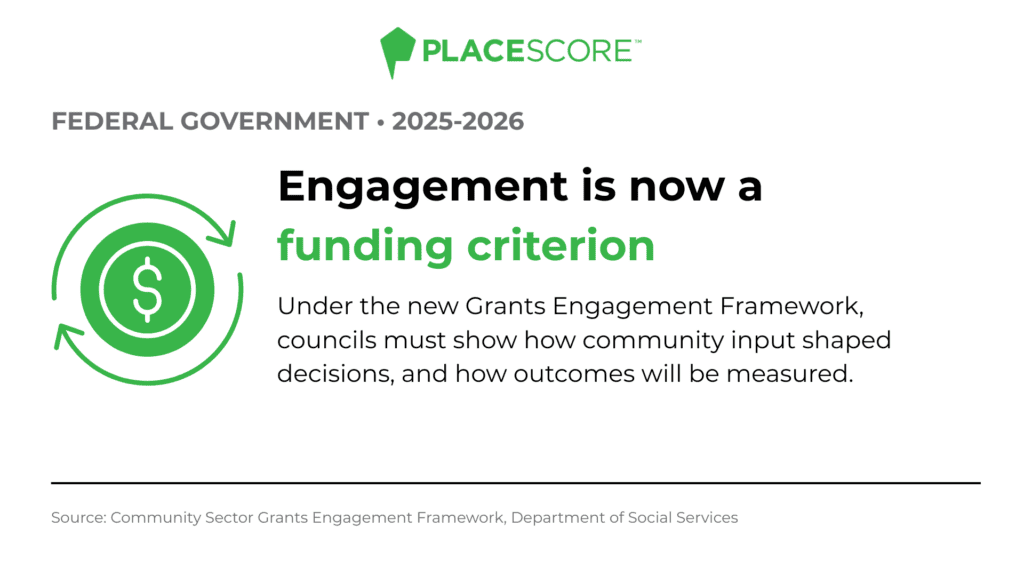
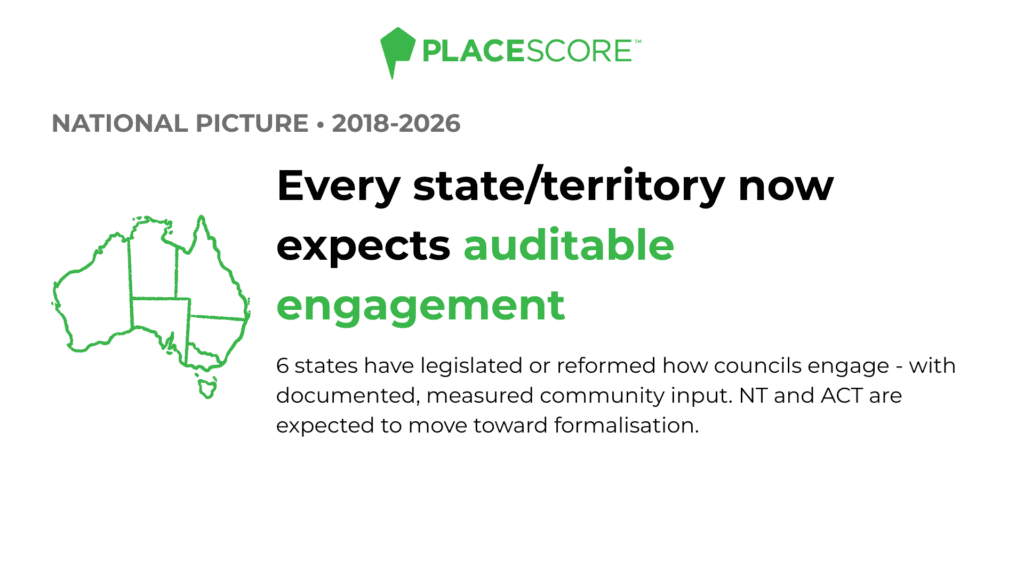
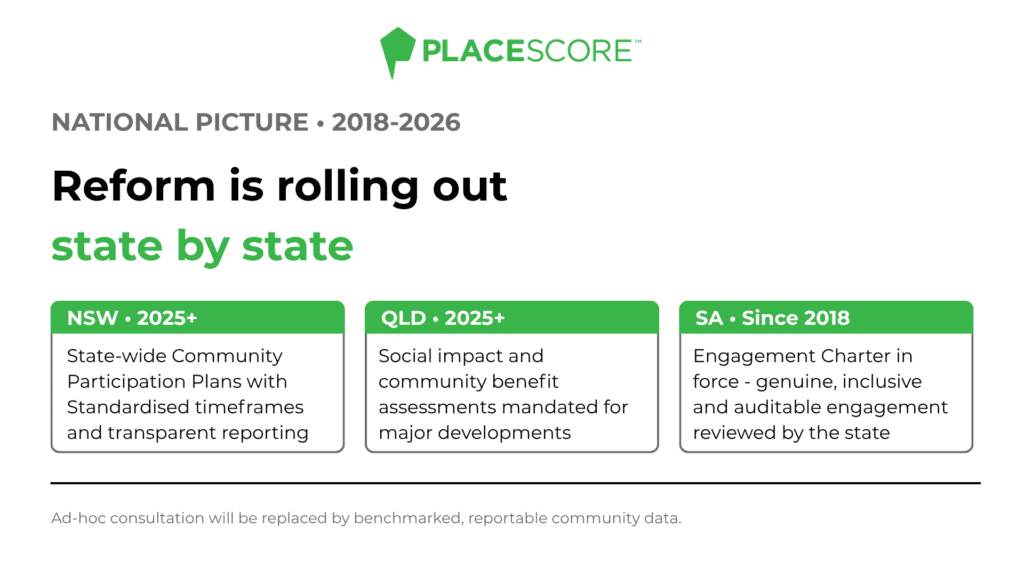
Across Australia, new regulatory regimes and community engagement requirements are coming into effect or being expanded. In Western Australia, Class 1 and 2 councils will be required to undertake representative service satisfaction research, while at the Federal level, the Community Sector Grants Engagement Framework will require local governments to develop monitoring, reporting and evaluation to support funding requests.
Councils will increasingly need to demonstrate not only that they consulted, but also how they used that feedback to reach an outcome. In that light, engagement becomes a compliance and performance issue as well as one of community trust and legitimacy.
Data-rich engagement gives councils the means to demonstrate accountability, such as tracking satisfaction with services over time and comparing with national benchmarks.
Actionable insights from community data
Collecting data is one thing; converting it into data, and then actionable insight is another. Place Score positions its dashboards as a key mechanism for making community feedback operational. Using filters by geography or demographic group, local government staff can determine what residents care about most, how they feel services are performing and where investment may be required.
For example, a council might run their community satisfaction survey through Place Score to ask what amenities residents feel are lacking in their neighbourhood. The data dashboards allow project teams to cross-reference responses by age, location or communities of interest.
This can provide a clear indication of what to prioritise across councils’ wide service offering, from safety to recycling.
This kind of insight can directly influence strategic planning, capital investment decisions and community communications. Instead of relying on anecdotes or reacting to issues, councils can base decisions on what the community has stated matters most and then track whether the decision made a difference.
Supporting reporting and funding applications with evidence
Another major benefit is the way data collection supports reporting, analysis and funding applications.
Whether a council is required to report to a state oversight body, respond to budget scrutiny or apply for grant funding, having rigorous, benchmarked community data builds credibility.
In many funding environments, evidence of community need, engagement and measurable improvement is a prerequisite. If a council can show baseline metrics, community perceptions over time, comparison with national or regional benchmarks and demonstrable change, the case becomes much stronger. Equally, transparent data can be shared with the community to show that ‘you asked, we listened, here is what we did’, thereby enhancing trust and social licence to operate.
Place Score’s engagement approach and data dashboards support internal planning and external reporting, so councils can always prove their projects’ value and impact.
Implementing a data-led engagement approach
For councils seeking to move from ad-hoc consultation to strategic organisational engagement, the key steps include selecting a methodology that provides representative sampling, geographic and demographic insight, transparent national benchmarking and enables longitudinal tracking. This also means ensuring that questions are clearly aligned with strategic priorities and embedding data dashboards into routine planning and reporting.
Staff training and governance processes will also need to be strengthened so that community feedback translates into streamlined planning, action and reporting. In doing so, the organisation moves from simply doing ‘consultation’ to systematically aligning its community’s voice with investment, strategy and outcomes.
As local government continues to face evolving community expectations and regulatory demands, a data-driven community engagement model offers considerable strategic advantage.
By embracing new engagement methodologies supported by innovative technology such as those offered by Place Score, councils can reduce engagement investment while also improving efficiencies, transparency, and organisational alignment. Turning essential community insight into data helps track progress and support evidence-based decision-making. This will result in better community outcomes, more credible reporting and greater trust in the process.
Local government leaders who understand the value of systematic, data-led community engagement will be best placed to design services and infrastructure that truly reflects the needs of residents and prove that they are making a difference.
Ready to turn community sentiment into a strategic asset? Talk to us!
