

Client: City of Cockburn, WA | Project timeframe: 2024-2028
“We hadn’t had anything that allowed us to look at a large, diverse body of data, which is really the beauty of the Place Score data for us. We’ve also been moving toward more evidence-based planning at the City of Cockburn, with a more structured needs analysis approach. We had service provision models in place, but some were over 20 years old and no longer met the needs of today’s community. So having this rich data to work with has been incredibly powerful for us.”
Liz Lloyd, Strategic Business Analyst, City of Cockburn
The problem
The City of Cockburn is experiencing rapid population growth and ongoing urban expansion, creating increasing pressure on services, infrastructure, housing, and the natural environment. At the same time, community expectations around service quality and engagement continue to rise, while Council operates within tight budget constraints and the need to keep rate increases modest.
Cockburn needed a clearer, more representative understanding of community priorities and service performance to help navigate these competing pressures. This included understanding how needs and expectations vary across suburbs, how growth and environmental change are impacting service demand, and where limited resources could deliver the greatest community benefit. A more structured, evidence-based approach was required to move beyond reactive feedback and support informed, long-term decision-making.
The solution
Place Score partnered with Cockburn to establish a structured, alternating approach to community engagement through an LGA-wide Liveability Survey in 2024 and 2026 and a Service Satisfaction Survey in 2025 and 2027. This approach is designed to provide rigorous, consistent and comparable data for everyday decision making.
Targeted engagement strategies were used to ensure strong and balanced representation across suburbs, age groups, and genders. The Liveability Survey achieved good age balance in 2024, while the Service Satisfaction Survey in 2025 delivered a fully representative sample. This ensured the results reflected the broader community, not just the most vocal respondents, and created a reliable evidence base for decision-making across the organisation.
The outcome
The combined Liveability and Service Satisfaction results gave Cockburn a clear, representative picture of what matters most to the community and how well services are performing, at a time when liveability is declining more sharply in WA. Linking the two datasets helped the City distinguish between service delivery issues, awareness gaps, and misaligned priorities, enabling more targeted and effective action.
Awareness, visibility, and perception
One of the many stories the 2025 data revealed is that more than half of surveyed residents were unaware of the council’s business support programs. However, among those who did know about them, 89% said they were satisfied.
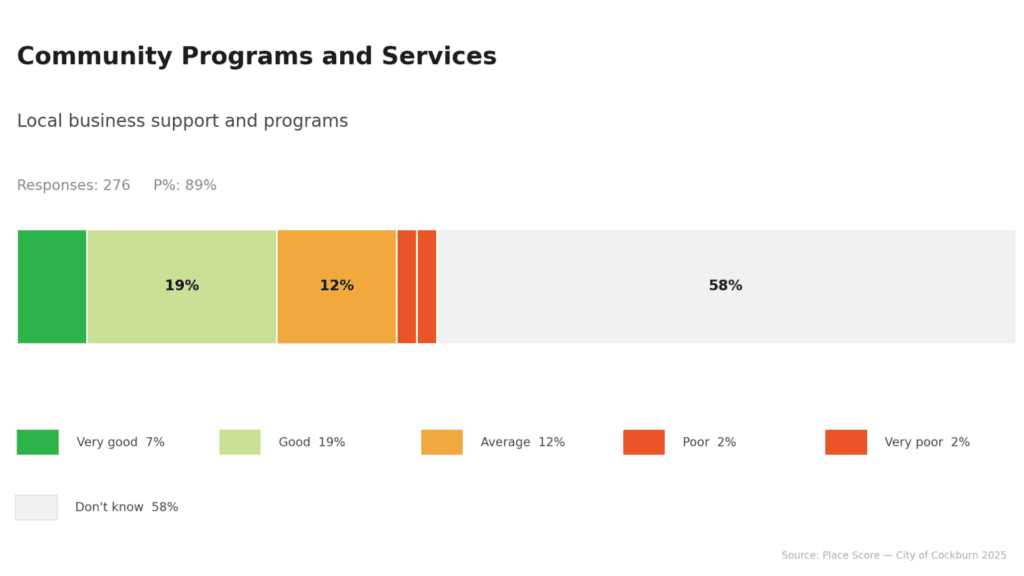
It’s a small finding, but it speaks volumes.
Sometimes satisfaction isn’t about performance. It’s about visibility.
People can’t rate something they don’t know exists. Interestingly, one of Cockburn’s liveability priorities for improvement is locally owned and operated businesses, suggesting that awareness and visibility of local economic initiatives directly influence how people experience their community.
Overall, the data reveals meaningful differences across age groups and suburbs, and will help Cockburn respond to demographic change, improve customer experience, and better target limited resources.
Findings were shared with the Executive Leadership Team and Council through dedicated workshops, building a shared organisational understanding. The insights now inform service reviews, investment priorities, and long-term planning, including the Strategic Community Plan 2025–2035, supporting transparent, evidence-led decision-making in a challenging growth and budget environment.
Want to know more? You can hear it directly from us!
