

Authors: Luke Starr, Lewis Colman
Under 25s make up 30% of the Australian population but are largely underrepresented as both decision makers and influences in our community. They will also be the group most impacted over the course of their lives by decisions planners make today. As such, planners have an obligation to better advocate for, and represent, the perspectives and preferences of young people accurately, which is why it is essential that youth continue to be a target of planning engagement.
Often, what we end up seeing in traditional community engagement is an under-represented turnout for youth. Which may lead us to the question, if young people can’t be bothered to share their opinions during community engagement, why should we care?
In 10 year’s time, these people are going to be key workers that contribute to the economy, first time homeowners, starting new families, and bringing new activity and people to our communities. If we ignore planning for the next generations, then we risk this group becoming increasingly disconnected, and moving elsewhere – most likely to places that do cater for their values and needs.
Any planning process that excludes the voices of young Australians in designing the spaces in which they live, work and play, not only fosters distrust in the planning process to facilitate meaningful change, but is potentially negatively impacting the lived experience of 3.2 million young people across Australia. This paper aims to explore the changing attitudes from young Australians regarding their local neighbourhoods in 2025 and to highlight the hidden disparities in their experiences compared with that of the rest of Australia.
Youth targets in the 2025 Australian Liveability Census
Place Score runs the Australian Liveability Census every two years (2021, 2023, 2025 etc). Our objective is to obtain proportional participation across metro and regional areas, states and territories, age and gender. In 2025, over 27,000 People participated.
Place Score committed to specifically targeting youth with the objective of collecting a representative proportion of the overall population, that is 16% of total responses.
The survey achieved this objective by setting this clear target and then developing a range of youth specific engagement materials including school and university partnerships and social media campaigns. 4,444 people under the age of 25 participated, sharing what’s important to them in their ideal neighbourhood, how they rate their current experience, and provided 3,360 ideas for changes that would improve their local places.
This paper discusses the results.
Differing perceptions of place for youth
Across the 2021, 2023 and 2025 census years, Elements of natural environment, General condition of public open space and Sense of personal safety have consistently been the three most important attributes to young Australians. Examining how both the long-term and rising values of young Australians are performing provides insight into the generational divide in place experience seen across Australia.
A major intergenerational disparity is the Net Promotor Score (NPS), which is 23 points higher for all Australians than youth (NPS +12 vs NPS – 11). This is despite the similar overall score given to Australia by all Australians and youth (PX 66 vs PX 65). These figures suggest a disconnection between young Australians and the places they live in, with most respondents not likely to recommend their neighbourhoods to a friend or colleague. Conversely, all other age groups in Australia had a positive NPS, suggesting that with more experience living in a neighbourhood, perceptions of belonging and community are stronger.


Mental health trends in youth
The mental health results also reflect this disparity among age groups, with all Australians, including youth providing high physical health scores, with 83% (All) and 79% (U25) of respondents reporting their health as either good, very good or excellent. However, mental health results had a much greater variation. 79% of all Australians reported their mental health as good or above whilst only 58% of youth did.
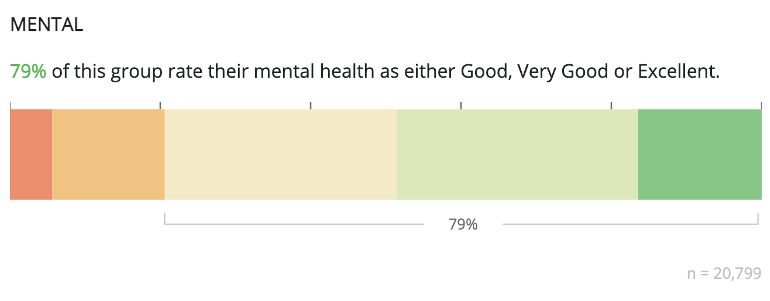
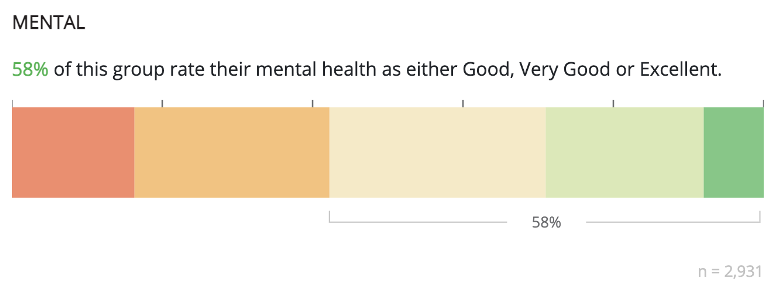
These results are not an outcome unique to 2025, with the previous two census years (2023 & 2021) also showing consistently lower scores from this demographic. This trend has been matched by an increase in various liveability priorities throughout this same period. This year, a higher value has been placed upon connectivity and accessibility for youth, with attributes such as Local employment opportunities (within easy commute) seeing a 4% increase in value since 2023, and 10% since 2021. Furthermore, the attributes Locally owned and operated businesses, Local community groups and organisations and Sense of belonging similarly rose, indicating an increasing desire for connection and ways to engage with nearby residents, spaces and businesses by young Australians.
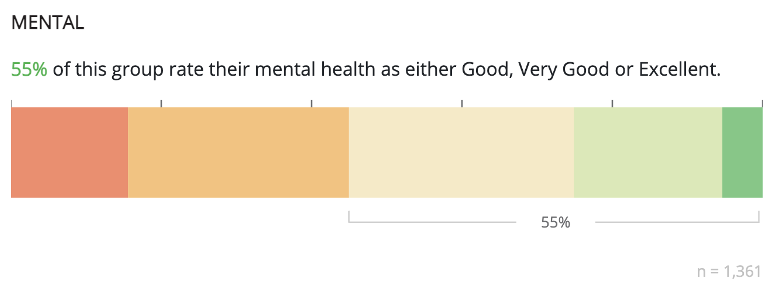
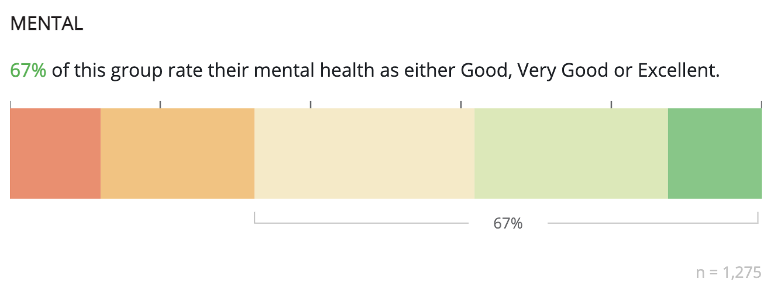
The disparities for young people are further concerning upon looking at the differences in gender groups, with 67% of young men rating their mental health as either good, very good or excellent compared with 55% from young women. This gendered gap is not seen amongst any other age group in Australia and raises significant concerns for planning. Furthermore, this draws attention to the fact that not all people experience spaces equally, and that urban planning requires a broad, inclusive lens that listens to a range of community voices.
Non-binary respondents under 25 represent a smaller sample size, however are no less important to consider. The mental health scores for this group are even more concerning, with only 28% indicating their mental health as good or higher. Additionally, Place Experience scores from non-binary youth are lower than the under 25 averages across all attributes, as well as having a low NPS of -27. These scores are reflective of the unique challenges faced by this demographic type that require increased recognition and protection to be reflected in societal attitudes and the spaces we live in.
Longitudinal attitude shifts in liveability
Between 2023 and 2025, the attribute Local employment opportunities saw the greatest reduction in Place Experience (PX) for youth, declining from 6.4 to 5.8. Locally owned and operated businesses, Local community groups and organisations and Sense of belonging all saw a decline of 0.3 points across this same period. It is interesting to note that all these attributes (except for Sense of belonging) were rated higher by young Australians than all Australians in 2025, however they were also valued higher and seem to be declining at a faster rate. This further supports the notion that young Australians value a strong sense of community and belonging, however, are not being provided with the resources to obtain it.
The attributes that have been consistently named as priorities for youth across census years (Elements of natural environment, General condition of public open space and Sense of personal safety) have all decreased by a total of PX 0.4 over the four-year period, whilst Connectivity has decreased by PX 0.5. The consistency in priorities for this group over the past four years can suggest a lack of action being made by decision makers to support youth in their local communities. Due to the lower engagement participation rates for this group, it is likely that these issues are not often raised or held to the same weight to that of other age groups.
Liveability in their own words
The feedback that has been drawn from over 4,000 youth respondents in the 2025 Australian Liveability Census shows that there are currently major limitations to young Australians accessing local services such as employment and housing, along with a desire to ensure future stability for both the environment and the economy. These have been identified and supported by community ideas gathered from this group. Over 3,300 ideas were submitted by Australians under 25, providing insight into the specific factors that contribute to, and detract from their ability to positively engage with their local areas.
More than one third of these ideas were related to movement. Safety, community, economy and open space were similarly common themes linked to ideas for improvement. Hidden issues were also revealed within the community ideas, such as limitations to accessibility for people of all abilities. Although issues such as these may impact an even smaller portion of the population, they are no less important to ensuring all people can fully utilise the spaces they live in. This is especially relevant when implementing responses to the local issues outlined above.
Moving towards a positive difference for youth
Data gathered through the 2025 Australian Liveability Census reveals that youth are both affected by the spaces they live in and are interested in creating better places. Perhaps not surprisingly, their concerns focus on housing, physical and social connection and environmental sustainability; all topics growing in value amongst this demographic.
Given that young Australians will be the next generation of workers, homeowners, and contributors to communities across the country, it is essential that these larger disparities in liveability, whether it be mental health challenges, or a lack of belonging, are directly addressed by planners, and are considered with the same weight as issues from any other age group. Ignoring the needs and ideas presented by young people in the Australian Liveability Census puts a substantial risk on the future liveability of the country and will have a negative effect on wellbeing, engagement, and interaction between people of all ages.
Most importantly, this year’s Census data is showing that young people are not asking for a lot in terms of liveability, yet small things like sense of community and accessibility are not being met, causing this continuous decline in the lived experience of young people. It is not as difficult as it may seem to solve the issues young people are facing, however, it is very important that action is taken sooner rather than later so that this trend does not continue into future years.
To explore more insights from our 2025 Australian Liveability Census:
